Quick answer
Mastery is the sum of several sources: talent nodes, equipped tools, certain perks, and temporary food buffs. If a recipe asks for 5 or 6 Mastery, you do not necessarily need to earn all of those points through Inspirations and Faith.
The most common early mistake is keeping rusty equipment and waiting for another sermon. Bronze-tier tools give more Mastery, while separate gear such as Bronze tools can add another branch-specific bonus. Many apparent Iron progression walls disappear as soon as you upgrade and equip the right items.
What is Mastery?
Mastery is your skill level in one of five work branches. It determines whether you can start many recipes and actions, and having more than the minimum requirement can also make work faster and more energy-efficient.
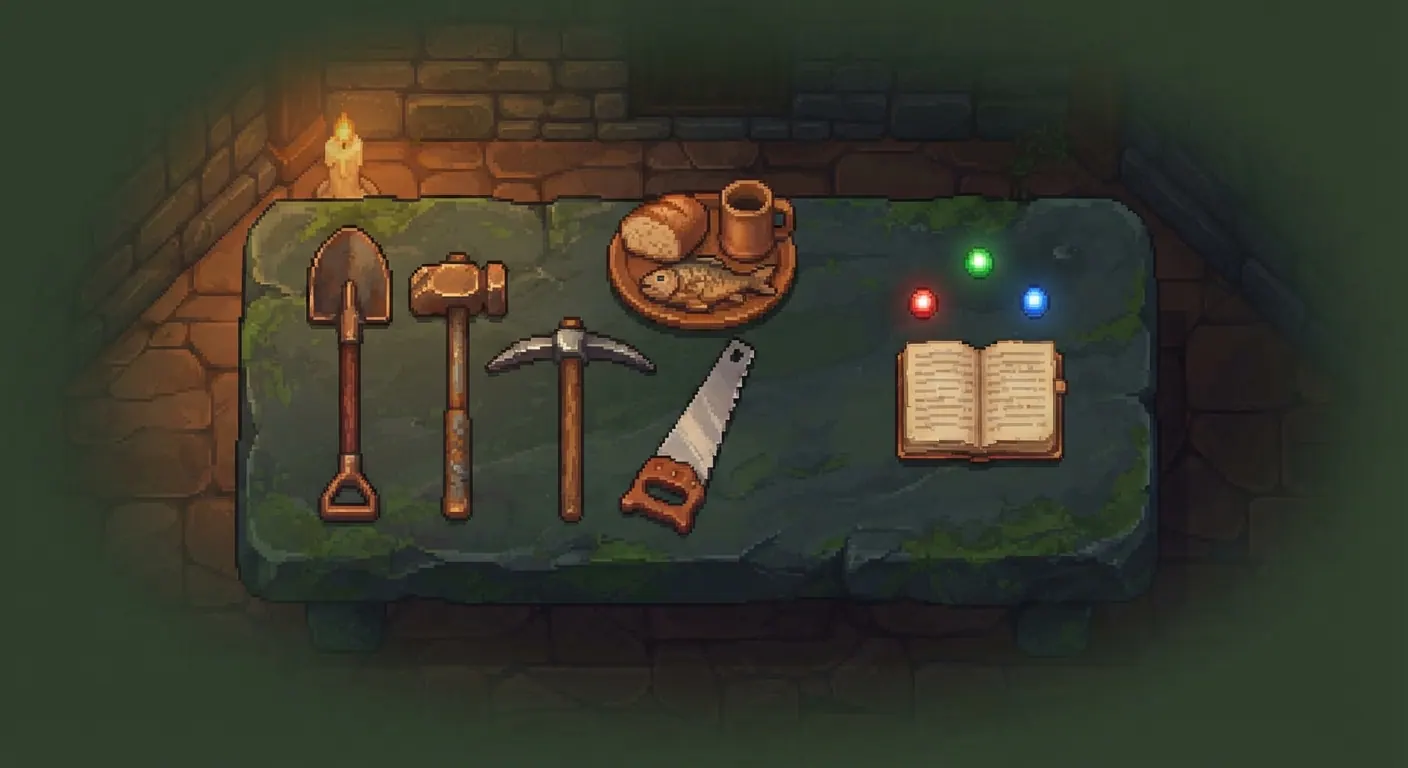
The game often represents the branches with coloured icons instead of large text labels:
| Branch | Covers | Main tool bonuses |
|---|
| Building | wood, stone, mining, carpentry, masonry, construction | Axe, Pickaxe |
| Farming | garden beds, cooking, brewing, fishing | Shovel, Fishing Rod |
| Smithing | Furnace, Anvil, Smithy, jewellery, glass | Hammer, Small Tools |
| Book writing | Writing Desk, paper, printing, Study Table | Books, Talismans |
| Anatomy | autopsy, embalming, alchemy, resurrection | Surgical Kits, Alchemist's Kits |
So “I need Mastery 6” is not enough information. You need to know which branch the recipe checks.
What contributes to your Mastery?
Your current value is built from several bonuses.
1. Talent-tree Mastery
Every branch begins with a base talent value of zero. The first node in each branch normally gives +1 Mastery.
To earn more talent points, you advance that branch through Inspirations. You perform relevant activities, claim completed Inspiration levels, gain talent experience, and eventually earn points to spend in the tree.
Inspirations are important, but they are not the only way to raise the final number shown to a recipe.
For the full progression loop, see Faith and Inspirations Explained.
2. Tools on your toolbar
This is the bonus players miss most often.
Tools add Mastery while equipped on your toolbar, even when you are not actively holding that specific tool.
The basic progression for normal tools is:
rusty: +1 Mastery;
bronze: +2;
iron: +4;
steel: +6.
A branch can count up to two relevant tool types.
For example, Building uses both Axe and Pickaxe. If both are Bronze tier, those two slots already provide Building Mastery 4 before talent bonuses.
That is why upgrading tools has such a large effect on progression.
Why Iron feels artificially gated
A lot of launch-week players hit the same sequence:
- 1
Iron Ore is already available;
- 2
the technology is unlocked;
- 3
the next recipe asks for Mastery 5 or 6;
- 4
there is not enough Faith for another talent point;
- 5
it looks like the game is forcing another full weekly cycle.
Then they notice that they are still using rusty tools or have not crafted the separate Bronze tools gear item used by Smithing.
This was one of the most repeated progression questions immediately after release.
If Iron is the thing blocking you now, read How to Get Iron Early next.
“Bronze tools” can mean a separate equipment item
This naming is especially easy to misread.
When another player says “craft Bronze tools,” they may not mean Bronze Axe, Bronze Hammer, and so on. There is also a distinct equipable item literally called Bronze tools for the Smithing branch.
It uses its own equipment slot and contributes additional Smithing Mastery.
That is why you can think “all my tools are already bronze” and still be sitting at Smithing 5 instead of the required 6.
Check every gear slot in the character screen, not just the obvious hand tools.
3. Some perks add conditional Mastery
Certain perks increase Mastery only for specific recipes, materials, or categories of work.
For example, progression includes bonuses that make working with Iron easier without permanently raising every Smithing recipe by the same amount.
Always read the perk description. A +Mastery symbol does not necessarily mean a universal branch-wide bonus.
4. Food can temporarily raise Mastery
Several dishes provide temporary branch bonuses for roughly one in-game day.
Examples include:
Vegetable Salad — Anatomy bonus depending on quality;
Bowl of Sauerkraut — Book writing;
Muffin — Farming;
Pumpkin Soup — Building;
Soldier's Stew — Smithing.
This is useful when you only need to clear a requirement once and do not want to restructure your entire talent path for one craft.
What happens below the Mastery requirement?
For ordinary workstation recipes, the rule is simple: you cannot start the job.
Some systems work differently, though.
Autopsies and star-quality recipes such as cooking can still allow the action at lower Mastery, but individual work steps have a lower success rate and the final quality can suffer.
So Mastery is not always a binary lock. In some systems it also controls consistency and output quality.
Is there any reason to exceed the requirement?
Yes.
At exactly the required value, the job works normally. Above the requirement, higher Mastery can make each work swing advance the craft by more progress.
Because Energy is charged per swing rather than per percentage point of progress, higher Mastery can effectively reduce both time and energy cost.
Better gear remains useful even after it stops unlocking greyed-out recipes.
Why does my Pickaxe not solve an Iron Ore requirement?
Because not every action that visually uses a mining tool belongs to Building.
Iron Ore is a Smithing job even though you are physically breaking a rock. The recipe or object icon tells you which Mastery is checked.
That is an important rule throughout GK2: trust the branch icon in the tooltip, not the real-world logic of the animation.
Fastest way to find missing Mastery
If you are short by 1–3 points, check things in this order:
- 1
Toolbar:
are the best available normal tools equipped?
- 2
Extra gear slots:
have you unlocked a toolkit, talisman, book, surgical kit, or similar item?
- 3
Perks:
is there a conditional bonus for this material or recipe?
- 4
Food:
can a temporary buff bridge the gap?
- 5
Only then calculate how much Faith and Inspiration progress you need for a permanent talent upgrade.
This prevents the worst early mistake: spending scarce Faith in the wrong branch and then waiting another church cycle.
How is Mastery connected to Faith?
Faith does not convert directly into Mastery.
The actual chain is:
activity → Inspiration → Faith cost → talent experience → talent point → Mastery node
That is why tool upgrades are so powerful. They increase the final Mastery value without forcing you through the whole Inspiration cycle.
Zombies have their own Mastery
Your Mastery does not transfer to workers.
Every zombie has its own:
Mastery;
tools;
tech points;
talent tree.
If you can craft something manually but the zombie assigned to that workstation does nothing, inspect the zombie rather than your Keeper.
See How Zombies Work for the full automation checklist.
FAQ
Does a tool count if I am not holding it?
Yes. What matters is the toolbar/equipment slot. The appropriate tool contributes its bonus while equipped.
Do Axe and Pickaxe bonuses stack?
Yes, because they are two different tool types in the same Building branch.
Can a Rusty Axe and Bronze Axe stack?
No. They occupy the same tool type, so the upgraded version replaces the old one for Mastery purposes.
Should I level Inspirations or craft tools first?
You need both over time, but when you are only one or two points short, check equipment first. It is often the immediate solution.
Why am I stuck at Smithing 5 even with bronze equipment?
Check the additional Smithing gear slot and whether you can craft the separate Bronze tools item, plus any material-specific perk.
Can food actually unlock a recipe?
Yes, if the food buff raises the exact Mastery branch that recipe checks and the buff is active.